Monday, 25 March 2013

Blended Learning Model

Should we shift back to blackboard?

It has been over three months now since I have last blogged. This was probably a retrospective time for me. A time where I was questioning my existing teaching pedagogy, experimenting and still waiting for enough evidences to support my hypothesis for learning in the classroom. Well, would be soon blogging about all the hypothesis, experimentation and the theories behind learning that are developing in my classroom.
Recently between 21st to 23rd March ,2013, the IB Asia Pacific Conference was held at Kuala Lumpur. As usual like the last year , waited this year to follow all the excitement and learning  behind the conversations at the twitter hashtags. By now it is an established and justified fact that twitter has been till now the most influential learning platform for me. Since I am not still in a position where I could deserve a seat at the conference, nevertheless my own learning model proves once again that learning can take place even virtually from miles far away. I guess if it can happen for me, it would also happen for my students.
Thanks to all the twitter addicts and bloggers who generously shared thoughts , resources about the IBAP and also blogged about the same. One such blogger who was present there blogged about his whole learning and experience even before his return flight landed back to Australia. This is referring to Warrick who blogs at https://learningau.wordpress.com/about-2/. A special thanks to him as I came to know about so many important presentations, their content and impact on the IB Community. This is referring to the blog that he has written on Face to face or online learning? The case for blended learning? Reading this triggered an ever existing question in my mind , that is to understand the impact of the use of technology in the classroom, which/what is more important? The content that I teach, how I teach OR how the brain learns the content that I teach.

Reading the blog took me to reading further about Neuroscience and rewiring of the brain, where the book  "The Shallows, What the internet is doing to our brain?" by Nicholas Carr is referred to. The same book was also mentioned during the presentation at IBAP. In this book Carr argues the way Plato once argued that the technology of writing would destroy the art of remembering.

Carr argues that modern neuroscience, which has revealed the "plasticity" of the human brain, shows that our habitual practices can actually change our neuronal structures. The brains of illiterate people, for example, are structurally different from those of people who can read. So if the technology of printing – and its concomitant requirement to learn to read – could shape human brains, then surely it's logical to assume that our addiction to networking technology will do something similar?

In the article several critics, neurobiologists , psychiatrists, futurologists , neuroscientists , writers and novelists give their point of view, which amalgamating leads to a common conclusion that the changing pattern of communication is having a huge impact in shaping how the mind thinks and works. Sometimes this is so apt when I connect it to my own pattern of learning. Concentrating on the newspaper has become so very difficult as I tend to shift to the online versions of newspapers, rss and twitter feeds, flipcards and so on, on my smartphone. Reading e-books is always a better option than the hard copies which I hardly carry anymore. And I agree to the panel in their saying that my brain can respond more to small articles than concentrate on a larger one. Perhaps the wiring of the brain is actually changing. 

Connecting this to the discussion in the session at IBAP....the question under scrutiny was that should we as teachers move to blackboard, the old traditional method of study. This was the discussion by Metty Antony from Canadian International School, who mentioned the importance of development of a blended learning model where there is a remarkable balance between the traditional bricks and mortar system and the online learning. Quoting from Warrick's blog " This presentation will cover the impact of the Internet and its tools on learners, the different approaches and models of Blended learning, how the IB is leaning towards a blended learning environment and practical insights into what makes it work". 

With statistics revealed that by May 2013, 97% of the checking of IB answerscripts are going to happen online and forthcoming MYP batches to have on screen assesments, my belief in this transition period has all the more been confirmed. But I liked the blended learning model and reflecting on my hypothesis that with internet and remote learning the self learning increases, I think I now need to put some boundary conditions too. 


Monday, 3 December 2012

Linking Learner profiles with the use of technology

Are you using technology in your classroom? Do you think it is shifting you from practising the attributes of the IB learner profile?

 Let us revisit and rethink......


As one term in my new school comes to an end and we move off to a long winter vacation, it is actually a reflecting time for me on my teaching practises. What is it in this term that I have done the best, for which I can pat on my back? What is it that I need to sit and think and restructure in my teaching pedagogy. 

Well there are so many things I could think of writing but just don't get the time to do so. The most important thing that as an IB teacher which keeps intriguing me is , that "Is the use of technology in the classroom in my class, shifting me away from inculcating the attributes of the Learner Profile in myself and embracing the same amongst my students?''

Finally came across this wonderful Infographic......Read below the infographic to know about my interpretation and connection.....


  • The first point in the infographic hints at being a risk taker,by embracing the tech tools in your lesson planning , achieving learner outcomes, enhanced learning.
  • The second and third one hint at being open minded, understanding the change, not fighting with it but adapting to it for a better bigger picture.
  • The fourth one shows how we are good communicators and knowledgeable by using the various tools and reources to share the information  at the right time, in a convenient form with the students.
  • The fifth and sixth point shows we are good thinkers, who can think ahead of time for the betterment of our next generation.
  •  We are also balanced and principled at the same time  as we ourselves use the technology ethically and teach our students to so the same.
  • The seventh point shows that we ourselves are inquirers , framing questions to solve or portray a problem in so many different ways. And above all we are caring as we care for this present 21st century generation, understanding their needs and tailor making our lesson oblectives accordingly.
  • And last but not the least as I write about this , I am being reflective , reflecting on my actions, set goals and the outcomes.
So are you integrating technology in your classroom and have such questions coming up? This was my interpretation. What is yours?

Thursday, 15 November 2012

Mobile phones as data loggers in the IB classroom (Part 2)

Is the presence of mobile phones in the classroom empowering you as a teacher and your students...

Video analysis using mobile phone and logger pro...


As a sequel to my last blog post, this one goes to the benefits of another tool in the mobile phones that can be used as a wonderful aid to reinforce physics concepts and get some good Physics labs . A simple video of a motion and then inserting it into logger pro and going for a video analysis.

Recently my DP students have been learning projectile motion. When it comes to this topic they are always excited as the first thing that they can relate to with this is kicking a football. How desperate they become to test the theory on the field. But till now I was not using any strong mechanism to test this theory on the field as motion sensors were not fit for this.

This time we just had an exciting physics class on the field when all the students got a chance to give a football shot. The shot was recorded on their mobile phone and an analysis of the video on logger pro revealed the height of the shot, the range , the initial velocity of the kick and the angle of kick. When they analyzed the motion at different points then their concepts about projectile motion got strengthened. They were amazed to see how the horizontal component of the velocity remained the same throughout.


Analyzing a motion using this feature has actually provoked their thought process and now I can see lot of innovative ideas coming up , especially in design labs. Moreover they can just think out of the box now as analyzing any kind of motion has become so easy.


Waiting to see what wonderful ideas come up next from them.

Wednesday, 31 October 2012

Mobile phones as data loggers in IB classroom Part 1


How fast is technology changing and is the change useful at all....?


Well this is a question which is nowadays in everybody's mind and between the juggle that goes on sometimes the winner is probably the side which tries to go with the system that has been existent for so many years. But the mind needs to accept that expertise in explaining a concept seems to be slowly moving from the voice of the teacher in the classroom to the gadgets in use with the advanced technology. I have worked with sensors and interfaces in my previous schools , but in my current school I got the chance to get my hands on the new interface on sensors, Labquest 2 and a first rendezvous with it was just a WOW....


In IBDP Physics use of ICT in labs is mandatory and it is split into 5 catagories :
  1.  Data logging
  2. Spreadsheets
  3. Graph Plotting software
  4. Database
  5. Computer model or simulations
All these requirements have to be fulfilled atleast once and hence teachers have to use sensors as a part of data logging. Sensors are a useful method of collecting data with precision and accuracy and a direct data analysis can be obtained by connecting the sensor to the laptop. We use a logger pro software for handling the data and graphs. What I found new was these Logger Pro installation CDs had a special version for Mac laptops. The Labquest Interface helps to connect the sensor to the laptop. 

The revolutionary change made in this interface is that it is wifi enabled. Hence data collection and analysis is not limited to the one interface but can be obtained in all the laptops and hangon....also on all the ANDROID and APPLE phones in class. The sole requirement is that all of them need to be connected to the same Wi Fi. The interface generates a unique URL with an IP. address, which helps everyone to connect to the page on data collection. So when you press the keep button on the interface everyone can get the data in their device. And being available on the mobile phones makes it so easy for data collection outside labs. So now technology makes data accesible and available to everyone at the same instant.


Thus as technology is changing rapidly, so are the manufacturers, who understand the need for the change. The way this new interface has been developed, data collection happens so instantly in the classroom, whatever be the student strength.

As the students in my present school have a variety of supplementary gadgets starting from tablets to mobile phones, they really get more engaged and enthralled when they see their tiny devices getting converted to data logging instruments. So those who have not tried it, I advice , go ahead and try it and feel the change in the physics classroom.


Sunday, 30 September 2012

Kindle in the Classroom

Are you twisting technology to use it to its fullest potential? 


This post is going to highlight the various ways one can access books on kindle and have a wealth of information and knowledge at the fingertips.I always felt that we as teachers have to change , evolve and redesign our teaching pedagogy every year, to customize the needs of the digital generation. It is befitting if we could use the mobiles, tablets and the laptops given to our students in a better way to suit their study habits and at the same time achieve the desired benefits. 

Well Kindle apart from being just a range of tablets with lots of pre loaded and downloadable books has also an application part to it. So those who do not have kindle devices still can have the access to all those thousands of books in kindle on any devices that they have. Yes the good news is that also on a laptop.

Again being an IB Physics teacher, I always keep looking for stuff infused with technology that can help me, my students and also my two sons who are now in MYP 1 and 2.  So an overview of how kindle can be merged into the curriculum in Sciences that we deal with in MYP and DP. 

In Sciences, the scientific method of research and experimentation skill is an important one that we try to develop in the students. At the same time we need to connect our content to various other disciplines and hence an updated awareness of the happenings in all the branches of Sciences is a boon for teachers. Moreover to infuse TOK into the content is another important aspect of classroom delivery in the IB. 

Keeping all this in mind and the time crunch that we always have, I find kindle ebooks an easy and economic means to have access to wonderful books. And till now I have not paid anything for the books so thats wonderful.

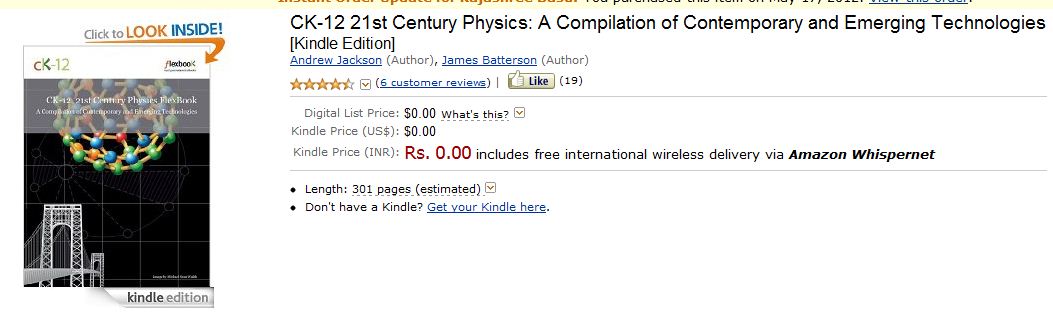
Well the above are the books in my Kindle library that I us for my classes as reference. The best are the CK-12 series which are updated constantly.

Few advantages that these books have:
  1. They can open up as e-books in your laptop, tablets and mobile devices, so reading on the go
  2. All the interfaces have wonderful dictionary to look up to the meaning of any word or phrase
  3. Highlighting option with short notes to have all important parts sorted at one place.
  4. And most of them is free or available at a throw away price. 
  5. All the books sync in all the devices that one use 
So those who have not tried it till now, just start off:

If you are a laptop/mobile/tablet  user..
  1. Visit http://www.amazon.com/ and make an account to open up a new world.
  2. Go to kindle ebooks
  3. Search the category of books and add to your library or send to your android/apple device.
  4. Download it into the device
  5. At the same time get Kindle cloud reader from the chrome web store for laptops
  6. OR download Kindle for PC and sync and download books for offline reading


Kindle ebooks that can be used as references to support the teaching of IB Sciences...

In this context I would like to mention that some books which I found of great use ,especially for the middle school and the high school are the CK-12 series of books which really highlights various aspects of scientific research skills. Moreover this series of books explains what goes behind developing a theory or a law and the differences between these and hypothesis. Interspersed are innovative practical demonstrations.


And of course lots of fiction and non fiction story books and novels for my sons in MYP to explore.So what are you waiting for? Whatever device you have just make an account in Amazon, start using the resources and share your experiences with the worrld.

Sunday, 23 September 2012

Exploring the various roles of an IB teacher

Are you exploring yourself  in the various role profiles of an IB teacher?

The last two weeks had been spent in understanding and setting into the culture of OIS. By now I get the feel that an IB teacher is actually an all rounder who can fit into various roles as the situation demands. In every school the roles that I had been given in the past helped me to discover a different ME, learn a whole lot of new things and realize my potentials. Hence I always look forward to a new role with the hope of shedding light on a different potential of mine. This post of mine is dedicated to all the IB teachers all around the world who deliver different roles with dedication and learn from each of them. Just a reflection that all the roles empower us with a new kind of wisdom, preparing us to face challenging situations.

In my present school I have to supervise two CAS programmes , one being that of service and the other action. I am fortunate to get both the activities aligned with my passion. The CAS Service project that I am supervising gave me the opportunity to visit with my student team to a Centre in Kolkata where I came across several little children who came from broken families, especially where the father was no more. Some of them had seen brutal deaths and were dealing with trauma. But an interaction with them revealed so many talented children who knew not only to communicate in English but also were very good instrument players. How smoothly they played their violin and guitar in tune to our OIS students. I really came out feeling so different in a reflective mood. There was so much to learn from these children , the most important being how to make the best use of your available resources and coming out as a winner. Even the way our OIS students taught them simple lessons of coordination and team spirit from music making was worth admiring. I guess my learning from the present generation just changes its form everyday.

Supervising the Action part was equally entertaining and informative. My team is the MUSIC MAKERS. Though I have never got any formal training on music but I am very passionate about singing. However this interaction with the team opened up different channels of knowledge gaining. Since I have students from Serbia, Poland, Bangladesh and India in the team, MUSIC will play a big role in tying us all together and I am looking forward to the kind of piece that is going to come out of it. But listening to some foot tapping music which had lyrics both in Polish and Serbian was mind blowing.Moreover I admired the ease and passion with which they played violin, guitar and tabla.

Well again I did try to mingle a little bit of technology into both. Students have been taught how to make websites in Google Sites and showcase their work. They are really excited. They are loving the editing by many platforms on it and to put up something on their own without a WEB DEVELOPER. also the privacy settings of Google Sites has given a new dimension. So looking forward to another side of exploration....

Wednesday, 12 September 2012

Skype Connectivity in the classroom

Connecting the previous passouts to the present batch students...


It has been a long time since I wanted to use the skype in my classrooms and really turn the class into a flatclassroom. So that learning was not just limited and confined to the walls of the room. I believe by now that a lot can be achieved by connectivity and so the best way to start off the same was to connect my previous batch students to the present ones. The interactive discussion would benefit both, I felt. The passed out batch could feel what it is like to be mentors and develop leadership skills. The present ones definitely would gain motivation from the previous ones.


Amit connected through skype...
As I had moved from Choithram International , my previous batch of physics students were not known to the present ones. This year in the exam of 2012, Amit Singhi had topped the school results and secured a 43, and thus is on his way to the London School of Economics. Second to him was Hemant Pankaj Pandit who is already in UK to join the University of Warwick. I am glad that they both accepted my invitation to connect and came LIVE into my classroom. 


Amit shared his experiences of being an IB student and how he had actually prepared for the exams, his TOK essay and EE. He emphasized on the following:
  1. Reading the textbooks thoroughly, even between the lines
  2. Referring to lot of web resources especially MIT lectures and other videos
  3. Reading the newspapers and get used to the terninology used currently in BM and ECO
  4. Writing a good personal statement 
  5. Getting good letter of recommendation for the subject courses applied
  6. Targeting a high predicted grade from teachers and working diligently towards it
Amit's score of 43 and his inspiring story really motivated the students .
Hemant engaged in a heart to heart chat with the students..

With Hemant next on board , joining us from UK , the interaction was a totally different kind. He highlighted that keeping a balance between having a good life and getting good scores in IB was possible and this gave our present students some respite. He said that if they are really looking forward to partying harder they should concentrate on their studies now, seriously getting good scores . The serious problem that he felt being an IB student was being motivated all the time inspite of all the pressure. The discussions were then open to clear individual queries.

I felt that the students could connect to Amit and Hemant as they had just passed through the stage that they were passing through.So what have the students gained from this interaction? Are you breaking barriers and connecting to the world. Soon will blog more about skype connectivity for my subject.....